Eng 繁中 日本語 한국어 简中

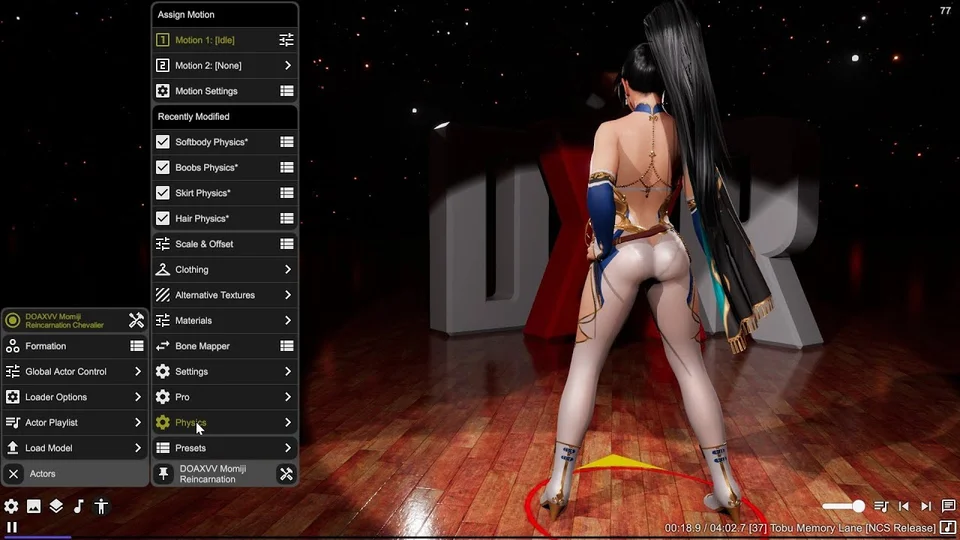
Softbody Physics

Connects selected bones with XPBD particle-based softbody simulation to simulate jiggly or deformable body parts like butts, belly, or chest.

Group Management

The Primary Group is always active and has full control over simulation parameters. Additional Groups adds up to 7 more groups, each with its own bone selection. Non-primary groups can inherit the primary group’s settings via Use Primary Group Settings to keep configuration consistent.

Bone Selection

Each group has a bone picker to select root bones. Child bones of selected roots become softbody particles. Use Suspension adds spring-damper anchor joints to root bones for additional support. Anchor Along Axis and Anchor Offset control how the softbody attaches to its parent.

Softbody Particles

The XPBD panel defines particle mesh parameters including depth, layers, subdivision, and constraint stiffness. See the Softbody sub-panel for detailed particle settings.

Visualization

Visualize Bodies renders collider shapes for softbody physics bodies. Visualize Joints shows joint limits for softbody physics joints.

Sub-Components

Primary Group

Defines a softbody simulation group. Select bones via the bone picker; child bones of selected roots become softbody particles. Optional Suspension adds anchor joints to root bones. Anchor Along Axis and Anchor Offset control the softbody attachment point. Non-primary groups can inherit the primary group’s physics settings. The nested XPBD panel defines particle stiffness, damping, and collision parameters.

Use Suspension

Adds a spring-damper suspension joint to a bone, anchoring it to its parent with configurable Anchor position and Center Offset. Spring Force, Damping, Mass, and Drag control the joint dynamics. Radius sets the collider size; Rest Angle adds a rotational bias. Rotation Limit constrains swing and twist angles with their own spring and damping. Visualize Joints renders the constraint shape.

XPBD

Defines a particle-based XPBD softbody mesh that deforms with physics. Child bones of each selected root become simulation particles arranged in layers extending outward. Depth controls how far particles extend from the bone; Edge Depth pulls edge particles closer to the skeleton for a tighter fit. Layers and Subdivision increase mesh resolution at the cost of performance. Depth Distribution shifts volume between inner and outer layers.

The constraint sliders (Volume, Edge, Rotation) control particle stiffness — higher values mean less deformation. Constraint Damping smooths oscillation between solver steps. Inertia adds resistance to rapid movement changes. Show Bones renders the original skeleton bones alongside the particle mesh for comparison.

Group 2

Defines a softbody simulation group. Select bones via the bone picker; child bones of selected roots become softbody particles. Optional Suspension adds anchor joints to root bones. Anchor Along Axis and Anchor Offset control the softbody attachment point. Non-primary groups can inherit the primary group’s physics settings. The nested XPBD panel defines particle stiffness, damping, and collision parameters.

Use Suspension

Adds a spring-damper suspension joint to a bone, anchoring it to its parent with configurable Anchor position and Center Offset. Spring Force, Damping, Mass, and Drag control the joint dynamics. Radius sets the collider size; Rest Angle adds a rotational bias. Rotation Limit constrains swing and twist angles with their own spring and damping. Visualize Joints renders the constraint shape.

XPBD

Defines a particle-based XPBD softbody mesh that deforms with physics. Child bones of each selected root become simulation particles arranged in layers extending outward. Depth controls how far particles extend from the bone; Edge Depth pulls edge particles closer to the skeleton for a tighter fit. Layers and Subdivision increase mesh resolution at the cost of performance. Depth Distribution shifts volume between inner and outer layers.

The constraint sliders (Volume, Edge, Rotation) control particle stiffness — higher values mean less deformation. Constraint Damping smooths oscillation between solver steps. Inertia adds resistance to rapid movement changes. Show Bones renders the original skeleton bones alongside the particle mesh for comparison.

Group 3

Defines a softbody simulation group. Select bones via the bone picker; child bones of selected roots become softbody particles. Optional Suspension adds anchor joints to root bones. Anchor Along Axis and Anchor Offset control the softbody attachment point. Non-primary groups can inherit the primary group’s physics settings. The nested XPBD panel defines particle stiffness, damping, and collision parameters.

Use Suspension

Adds a spring-damper suspension joint to a bone, anchoring it to its parent with configurable Anchor position and Center Offset. Spring Force, Damping, Mass, and Drag control the joint dynamics. Radius sets the collider size; Rest Angle adds a rotational bias. Rotation Limit constrains swing and twist angles with their own spring and damping. Visualize Joints renders the constraint shape.

XPBD

Defines a particle-based XPBD softbody mesh that deforms with physics. Child bones of each selected root become simulation particles arranged in layers extending outward. Depth controls how far particles extend from the bone; Edge Depth pulls edge particles closer to the skeleton for a tighter fit. Layers and Subdivision increase mesh resolution at the cost of performance. Depth Distribution shifts volume between inner and outer layers.

The constraint sliders (Volume, Edge, Rotation) control particle stiffness — higher values mean less deformation. Constraint Damping smooths oscillation between solver steps. Inertia adds resistance to rapid movement changes. Show Bones renders the original skeleton bones alongside the particle mesh for comparison.

Group 4

Defines a softbody simulation group. Select bones via the bone picker; child bones of selected roots become softbody particles. Optional Suspension adds anchor joints to root bones. Anchor Along Axis and Anchor Offset control the softbody attachment point. Non-primary groups can inherit the primary group’s physics settings. The nested XPBD panel defines particle stiffness, damping, and collision parameters.

Use Suspension

Adds a spring-damper suspension joint to a bone, anchoring it to its parent with configurable Anchor position and Center Offset. Spring Force, Damping, Mass, and Drag control the joint dynamics. Radius sets the collider size; Rest Angle adds a rotational bias. Rotation Limit constrains swing and twist angles with their own spring and damping. Visualize Joints renders the constraint shape.

XPBD

Defines a particle-based XPBD softbody mesh that deforms with physics. Child bones of each selected root become simulation particles arranged in layers extending outward. Depth controls how far particles extend from the bone; Edge Depth pulls edge particles closer to the skeleton for a tighter fit. Layers and Subdivision increase mesh resolution at the cost of performance. Depth Distribution shifts volume between inner and outer layers.

The constraint sliders (Volume, Edge, Rotation) control particle stiffness — higher values mean less deformation. Constraint Damping smooths oscillation between solver steps. Inertia adds resistance to rapid movement changes. Show Bones renders the original skeleton bones alongside the particle mesh for comparison.

Group 5

Defines a softbody simulation group. Select bones via the bone picker; child bones of selected roots become softbody particles. Optional Suspension adds anchor joints to root bones. Anchor Along Axis and Anchor Offset control the softbody attachment point. Non-primary groups can inherit the primary group’s physics settings. The nested XPBD panel defines particle stiffness, damping, and collision parameters.

Use Suspension

Adds a spring-damper suspension joint to a bone, anchoring it to its parent with configurable Anchor position and Center Offset. Spring Force, Damping, Mass, and Drag control the joint dynamics. Radius sets the collider size; Rest Angle adds a rotational bias. Rotation Limit constrains swing and twist angles with their own spring and damping. Visualize Joints renders the constraint shape.

XPBD

Defines a particle-based XPBD softbody mesh that deforms with physics. Child bones of each selected root become simulation particles arranged in layers extending outward. Depth controls how far particles extend from the bone; Edge Depth pulls edge particles closer to the skeleton for a tighter fit. Layers and Subdivision increase mesh resolution at the cost of performance. Depth Distribution shifts volume between inner and outer layers.

The constraint sliders (Volume, Edge, Rotation) control particle stiffness — higher values mean less deformation. Constraint Damping smooths oscillation between solver steps. Inertia adds resistance to rapid movement changes. Show Bones renders the original skeleton bones alongside the particle mesh for comparison.

Group 6

Defines a softbody simulation group. Select bones via the bone picker; child bones of selected roots become softbody particles. Optional Suspension adds anchor joints to root bones. Anchor Along Axis and Anchor Offset control the softbody attachment point. Non-primary groups can inherit the primary group’s physics settings. The nested XPBD panel defines particle stiffness, damping, and collision parameters.

Use Suspension

Adds a spring-damper suspension joint to a bone, anchoring it to its parent with configurable Anchor position and Center Offset. Spring Force, Damping, Mass, and Drag control the joint dynamics. Radius sets the collider size; Rest Angle adds a rotational bias. Rotation Limit constrains swing and twist angles with their own spring and damping. Visualize Joints renders the constraint shape.

XPBD

Defines a particle-based XPBD softbody mesh that deforms with physics. Child bones of each selected root become simulation particles arranged in layers extending outward. Depth controls how far particles extend from the bone; Edge Depth pulls edge particles closer to the skeleton for a tighter fit. Layers and Subdivision increase mesh resolution at the cost of performance. Depth Distribution shifts volume between inner and outer layers.

The constraint sliders (Volume, Edge, Rotation) control particle stiffness — higher values mean less deformation. Constraint Damping smooths oscillation between solver steps. Inertia adds resistance to rapid movement changes. Show Bones renders the original skeleton bones alongside the particle mesh for comparison.

Group 7

Defines a softbody simulation group. Select bones via the bone picker; child bones of selected roots become softbody particles. Optional Suspension adds anchor joints to root bones. Anchor Along Axis and Anchor Offset control the softbody attachment point. Non-primary groups can inherit the primary group’s physics settings. The nested XPBD panel defines particle stiffness, damping, and collision parameters.

Use Suspension

Adds a spring-damper suspension joint to a bone, anchoring it to its parent with configurable Anchor position and Center Offset. Spring Force, Damping, Mass, and Drag control the joint dynamics. Radius sets the collider size; Rest Angle adds a rotational bias. Rotation Limit constrains swing and twist angles with their own spring and damping. Visualize Joints renders the constraint shape.

XPBD

Defines a particle-based XPBD softbody mesh that deforms with physics. Child bones of each selected root become simulation particles arranged in layers extending outward. Depth controls how far particles extend from the bone; Edge Depth pulls edge particles closer to the skeleton for a tighter fit. Layers and Subdivision increase mesh resolution at the cost of performance. Depth Distribution shifts volume between inner and outer layers.

The constraint sliders (Volume, Edge, Rotation) control particle stiffness — higher values mean less deformation. Constraint Damping smooths oscillation between solver steps. Inertia adds resistance to rapid movement changes. Show Bones renders the original skeleton bones alongside the particle mesh for comparison.

Group 8

Defines a softbody simulation group. Select bones via the bone picker; child bones of selected roots become softbody particles. Optional Suspension adds anchor joints to root bones. Anchor Along Axis and Anchor Offset control the softbody attachment point. Non-primary groups can inherit the primary group’s physics settings. The nested XPBD panel defines particle stiffness, damping, and collision parameters.

Use Suspension

Adds a spring-damper suspension joint to a bone, anchoring it to its parent with configurable Anchor position and Center Offset. Spring Force, Damping, Mass, and Drag control the joint dynamics. Radius sets the collider size; Rest Angle adds a rotational bias. Rotation Limit constrains swing and twist angles with their own spring and damping. Visualize Joints renders the constraint shape.

XPBD

Defines a particle-based XPBD softbody mesh that deforms with physics. Child bones of each selected root become simulation particles arranged in layers extending outward. Depth controls how far particles extend from the bone; Edge Depth pulls edge particles closer to the skeleton for a tighter fit. Layers and Subdivision increase mesh resolution at the cost of performance. Depth Distribution shifts volume between inner and outer layers.

The constraint sliders (Volume, Edge, Rotation) control particle stiffness — higher values mean less deformation. Constraint Damping smooths oscillation between solver steps. Inertia adds resistance to rapid movement changes. Show Bones renders the original skeleton bones alongside the particle mesh for comparison.