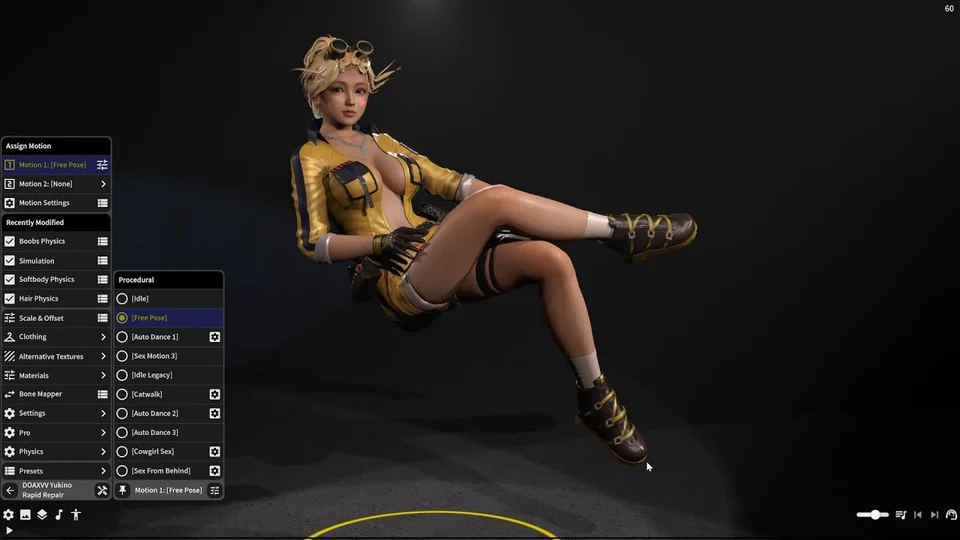
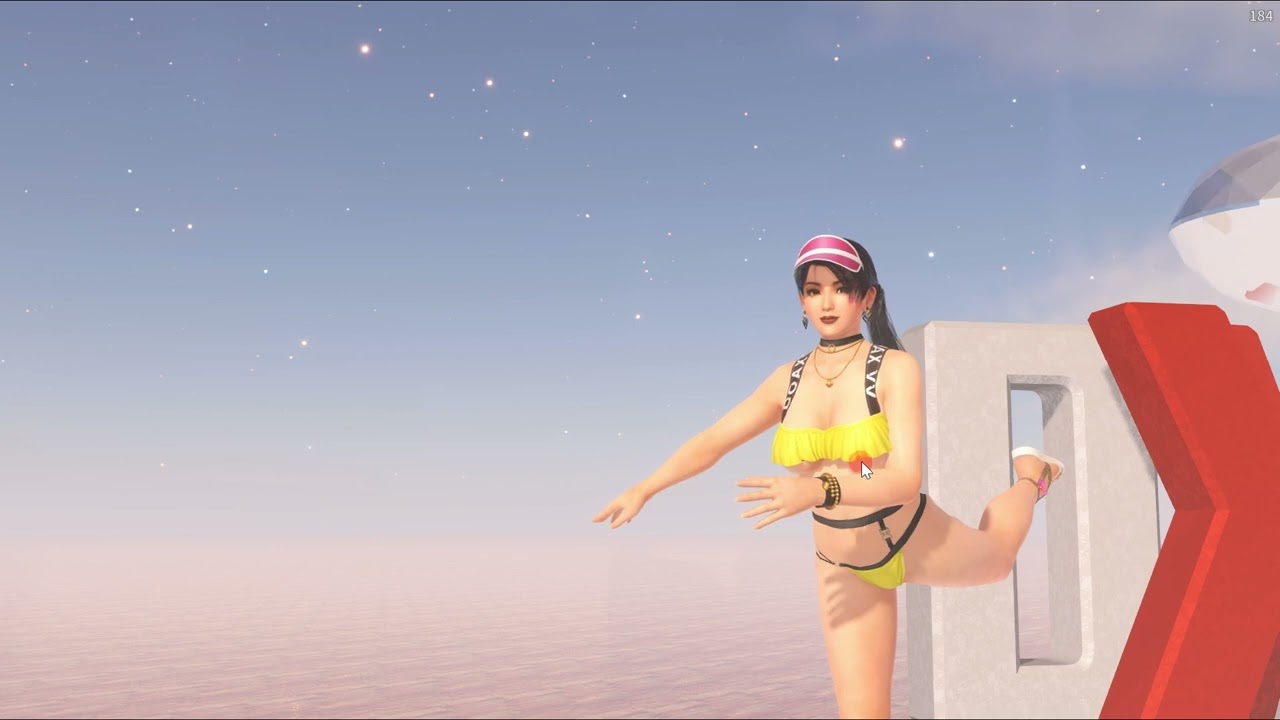
Free Pose
Free Pose turns the actor into a self-balancing puppet you pose by hand. Nothing is animating — the balance solver owns the whole pose. Grab any limb, the torso, or the head and drag it; the solver keeps the character balanced over its feet while standing, or over a locked seat while sitting. Pins are remembered, so a released limb stays where you leave it.
Start posing
Select Free Pose from the procedural motion list. This replaces the actor’s active motion with balance-driven posing. Use Reset to release pins and return to a neutral stand.
Mouse users drag the body handles and scroll to adjust depth. In VR, use the controller ray to drag, or grip a body handle directly to move it with your hand. Start with both feet on the floor before trying a raised-foot or seated pose.
Posing & Pinning
Drag a hand/arm or foot/leg to move that limb; the grab rides the pointer ray at a fixed depth, so moving the camera (or scrolling) sweeps it nearer and farther. The target is clamped to the limb’s natural reach, so it can’t collapse into the joint or lock dead straight. Hands stay put where you release them. Feet use dwell-to-pin: hold the drag still until the marker tints green to lock the foot in the air, or release while it is still red to let the leg drop and settle to the floor. The Reset action drops every pin and returns the actor to a neutral stand.
Weight Shift & Sway
Shift Smoothing is the time the body takes to transfer weight from one foot to the other — larger feels slower and heavier. Sway Amplitude adds a small idle quiet-stance drift so a standing pose doesn’t look frozen; set it to 0 for a dead-still hold.
Support & Solver
Support Radius is a slack disk around the weighted stance: COM excursion inside it counts as balanced and draws no hip correction, so a larger radius gives a looser, lazier-looking balance. Solve Iterations is how many passes the pose solver runs each frame — raise it for tighter limbs at a small cost, lower it to save time.
Leg Springs
The body is a single mass at the pelvis, held up by each grounded leg acting as a spring; the knee bend, the catch on landing, and the standing wobble all emerge from these. Sim Gravity is the downward pull that compresses the legs. Leg Stiffness sets how firmly a leg resists that compression (softer legs sink into a deeper crouch), and Leg Damping is the landing give that keeps a planted foot from bouncing.
Stance Control
Stance Stiffness and Stance Damping are the horizontal controller that holds the pelvis over the base of support — stiffer reacts faster but can feel rigid, more damping keeps quiet stance from jittering. Relax Rate is how quickly a released leg eases back toward its resting pose.
Sitting
Drag the torso (waist) and hold still to lock it as a seat: the body then rests on it like a stool, and both feet are free to lift and dangle without bearing weight. A quick drag-and-release of the torso, or Reset, stands back up. Because a seated pelvis can’t slide to chase balance the way a standing one does, balance is kept by tilting the upper body opposite the legs. Seat Radius is the support disk around the seat inside which no tilt is applied. Seat Lean Gain sets how hard the upper body leans to counter a leg that’s been moved, and Seat Lean Max caps that angle — turn the gain up for a stronger, more visible counterbalance, down if it overshoots. Seat Stiffness and Seat Damping tune the spring that settles the pelvis onto the seat after you release the drag.