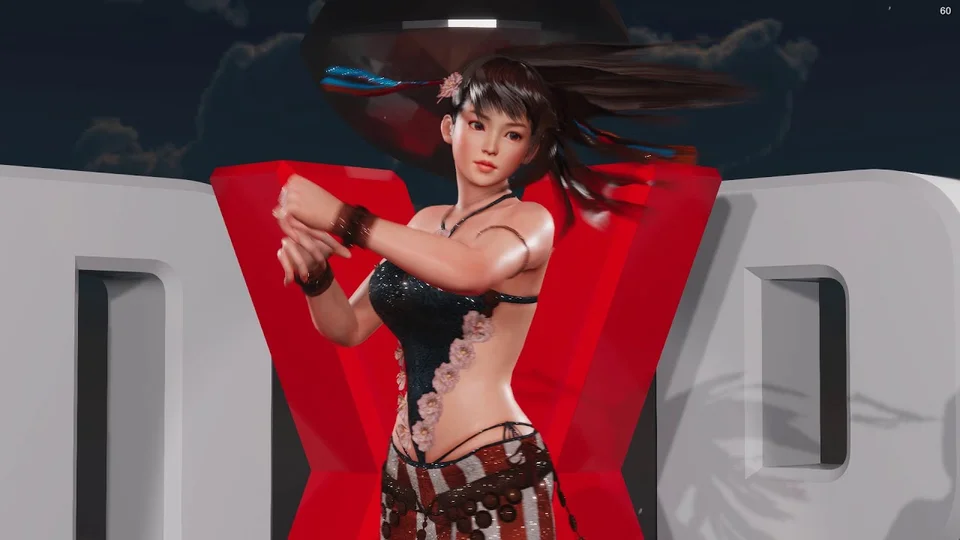
Hair Physics
Applies chain physics to hair strands on the model. Selected root bones are connected into a physics chain where each child bone swings and bounces driven by spring-damper dynamics.
Bone Selection
Use Select Bones to pick root hair bones — the system automatically traverses children to build the chain. Skip First X Bones leaves the root bones unattached for a firmer base. Max Levels caps chain depth (0 = unlimited). Presets let you save configurations across different models.
Physics Mode
Auto follows the system-wide default. PhysX uses joint-based rigid body physics with capsule or sphere colliders. XPBD uses a particle-based simulation that can be more stable for long chains. The mode determines which settings panel is shown.
PhysX Settings
Visible when using PhysX mode. Spring Force (logarithmic) controls stiffness — higher values keep hair closer to its rest pose. Damping reduces oscillation. Stiffness Reduction softens the spring at each chain level so tips flop more freely. Twist Limit constrains rotation around the bone axis. Limit Force controls how hard the joint pushes back against its constraints. Mass and Drag affect inertia and air resistance. Collider Radius sets the collision sphere size; Collider Length scales it along the bone as a capsule. Anchor Position chooses where the joint attaches (0 = parent bone, 1 = child bone).
XPBD Chain
Visible when using XPBD mode. Configures particle-based chain simulation with Rotation Compliance, Twist Compliance, Stiffness Reduction, Mass Reduction, and Constraint Damping. Particle Anchor controls attachment position. Collision layer is set to Hair for interaction with the rest of the scene.
Visualization
Visualize Bodies renders collider shapes for physics bodies. Visualize Joints shows joint limits and drive targets as wireframe gizmos.
Settings reference
XPBD mesh settings (XPBD)
Configures particle-based chain or mesh simulation for hair, cloth, and other dangling parts. Rotation Compliance controls how much the chain bends at each joint (higher = more flexible). Twist Compliance controls rotation around the bone axis. For mesh mode, Lateral Compliance adds cross-connections between adjacent chains.
Stiffness Reduction (power-of-10 scale) multiplies compliance at each level — values above 1 make the chain progressively looser toward the tip. Mass Reduction (power-of-2 scale) reduces mass at each level. Particle Anchor positions the joint along the segment. Constraint Damping smooths oscillation between solver steps. Inertia adds resistance to movement changes. Particle Radius sets the collider size in millimeters. Use Sphere Shape replaces capsule particles with spheres for debugging.